
All Articles
Clinically Reviewed by Body In Balance Team
September 30, 2026
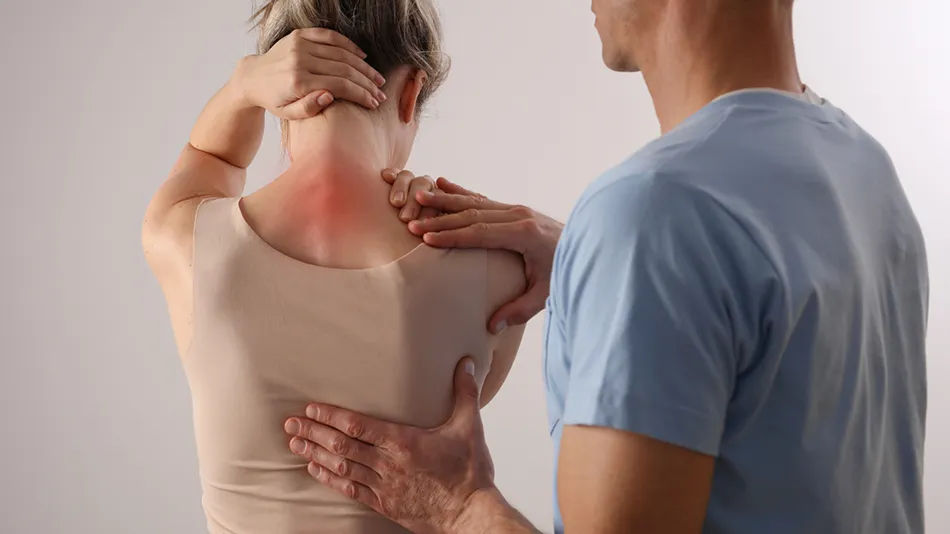
If you’ve ever felt a sudden, sharp pain between your shoulder blades that catches when you twist, reach, or take a deep breath, you may have described it this way: “I think I have a rib out.”
We’ve heard some version of that thousands of times over nearly two decades in practice. It can start after a workout, after sleeping in an awkward position, or when someone reaches for something and twists the wrong way. Every so often there’s no obvious cause at all.
In most cases the rib hasn’t actually moved out of place, but that doesn’t mean the pain isn’t coming from the rib.
What People Mean When They Say a Rib Is “Out”
Your ribs don’t float around underneath the skin. Each one attaches to the thoracic spine through small joints in the back and then wraps around toward the chest. Those joints move every time you rotate your upper body, reach overhead, or breathe in.
When one of these areas gets irritated or stiff, it can cause a sharp pain that’s easy to pinpoint, and patients can often point to the exact spot with one finger. It may feel like a knot just inside the shoulder blade, or it may catch when they turn one direction, take a deep breath, cough, or sneeze. Occasionally the discomfort wraps a little way around the side of the chest.
That’s the feeling people have come to call a “rib out of place,” and the phrase makes sense because it does feel like something needs to shift back. Most of the time, though, the rib hasn’t dislocated or moved in any dramatic way.
So What Is Actually Hurting?
The pain can come from the small joints where the rib meets the spine, the joints of the thoracic spine itself, or the muscles and connective tissue around the ribs and shoulder blades. Because these structures all affect each other, it’s often more than one of them.
When part of the upper back stiffens, the muscles around it tend to tighten to protect it. When the muscles between the ribs get irritated, breathing and twisting become uncomfortable. And after eight hours hunched over a computer, the thoracic spine and rib cage may not be moving well by the end of the day. That’s why working on only the sore muscle doesn’t always fix things, since the muscle may be tight because it’s guarding something underneath.
“But It Feels Like It Needs to Pop”
Patients tell us this all the time. There’s a strong sense that if you could twist far enough or stretch in just the right direction to get that spot to pop, everything would let go, and some people spend days twisting over the back of a chair trying to make it happen.
We don’t recommend that, because a popping sound isn’t the goal. When we evaluate this kind of pain, we’re looking for the area that isn’t moving normally and checking whether restoring motion there actually changes the symptoms, which tells us far more than whether something cracked.
Why Does It Hurt When I Take a Deep Breath?
Your rib cage expands every time you breathe, so the ribs and their joints move with each breath. If one of those joints or the tissue around it is irritated, a deep breath adds movement right where it hurts and can bring the pain back. That alone doesn’t mean something dangerous is going on.
It is a good reason not to diagnose yourself, though. Chest and upper-back pain can sometimes come from the heart, lungs, or digestive system instead of the muscles and joints, and we list the warning signs to watch for further down.
Why Does This Happen in the First Place?
Sometimes there’s an obvious cause, like a hard workout or moving furniture, but often it builds gradually. Someone sits at a desk with rounded shoulders for years, the thoracic spine gets less mobile, and the muscles around the shoulder blades have to work harder to make up for it. Then a small, ordinary movement finally sets off the pain.
We’ve written about the same pattern with posture and back pain. The movement that finally hurts usually isn’t the one that caused the problem, just the last thing to pile on.
Treating Rib and Upper-Back Pain
The first step is making sure the symptoms look musculoskeletal. We check how the thoracic spine and ribs move, along with posture, shoulder mechanics, and the surrounding muscles, and we pay attention to whether breathing, rotating, raising an arm, or certain positions bring on the pain.
If the exam points to stiff or painful movement in the thoracic spine or rib joints, a chiropractic adjustment can help restore motion there. Some patients feel better quickly, while for others the joint turns out to be only one piece of the problem. There may also be real tightness in the rhomboids, trapezius, the muscles along the spine, or those around the rib cage, and that’s where massage and soft-tissue work help.
We built our clinic so chiropractic and massage work together rather than compete, which lets us use both when a patient’s problem calls for it.
What Does the Research Say?
Research on thoracic and rib manipulation is still developing, and we wouldn’t claim that every case of pain between the shoulder blades should be adjusted. What the research does support is that these areas are connected. In a 2009 study of patients with shoulder pain, manipulation of the upper back and ribs was followed by an immediate drop in shoulder pain and better shoulder motion. It was a small study of 21 people without a comparison group, so it doesn’t prove cause and effect, but it lines up with what we see in practice and is one reason we look beyond the single sore spot.
When It Probably Isn’t Just a “Rib Out”
A familiar, localized pain that changes with posture, movement, touch, or breathing usually points us toward the muscles and joints, but not every sharp pain in this area belongs in a chiropractic office. Get prompt medical attention for new or unexplained chest pain, severe chest pressure, trouble breathing, dizziness or faintness, unexplained sweating, a significant injury, fever, coughing up blood, or pain that feels different from anything you’ve had before.
Part of a good chiropractic exam is recognizing what we shouldn’t treat, not just what we can.
How We Approach It
We know the feeling people mean when they say they have a rib out. In our clinic we examine the area, find which movements bring on the pain, and decide whether chiropractic care, massage, home exercises, or some combination makes the most sense. Sometimes that sharp spot responds well once normal movement comes back, and other times we find the pain is coming from somewhere else, which is something we’d rather learn before we start treating it.
Body In Balance Chiropractic & Massage is near Vancouver Mall and sees patients from Hazel Dell, Salmon Creek, and across Clark County. If you’ve been walking around saying “I swear I have a rib out,” we’d be glad to help you figure out what’s going on.


